
Direct Answer:
To build good habits that stick:
- Start with one habit.
- Make the habit embarrassingly small.
- Attach the habit to something you already do every day.
- Use the Pomodoro technique to focus on the habit.
- Design a suitable environment
- Show up consistently, not perfectly, even on bad days.
Have you ever been in the situation below?
It’s Sunday night. You tell yourself, ‘Tomorrow is different, and I’ll definitely live by it throughout the whole week.
You create a solid routine: a new habit, a fresh start, and a real commitment this time.
Monday goes well. Tuesday and Wednesday too. Unfortunately, you feel exhausted after work, and the routine ends by Thursday.
If this sounds like you, you’re not alone at all. I used to be one of the victims trapped in the cycle.
In fact, not being able to keep up with habits has nothing to do with your character. Instead, it’s a system problem.
Most habit advice is specifically tailored for people with sufficient energy and free time.
But if you’re working a full-time job and feel drained after arriving home at 6 PM, most of that advice doesn’t fit your life.
In this guide, we will walk through how to build good habits that actually last, not through willpower or a perfect routine, but through an organized system that works even on the days you don’t feel like it.
Step 1: Pick One Habit, Not a Life Overhaul

The biggest mistake people make when trying to develop good habits: they try to change everything at once, hoping for overnight success.
New sleep routine, better diet, daily reading, and exercise: you execute them all at the same time. As a result, the whole thing collapses.
That’s not a motivation problem. That’s cognitive overload. Your brain treats too many new tasks as enemies and resists them all.
The fix is super simple: pick one habit. Just one. For the next 30 days, that’s the only thing you’re working on. You can always add a new habit after getting used to the tempo.
How to Choose the Right Starting Habit
Not all habits are equal when you’re starting. The right first habit follows three criteria:
- Low friction: it takes under 5 minutes to start, not more than that.
- After-work friendly: It works when you’re mentally tired, not just when you’re fresh.
- Directly connect to something you care about: vague habits disappear fast.
Here are some real examples built for John’s life:
Habit Goal | Realistic Starting Version |
Read more | Read 2 pages after changing out of work clothes |
Build a skill | Watch one 10-minute tutorial after dinner |
Exercise | Do 5 minutes of movement before showering |
Work on a side project | Open the file and write 3 sentences, nothing more |
Meditate | Sit quietly for 2 minutes before checking your phone |
None of these is impressive. That’s the point. Impressive habits don’t survive tired Tuesday evenings. Small ones do.
Step 2: Make the Habit So Small It Feels Almost Embarrassing
If the habit doesn’t feel slightly too easy, it’s probably too big. The goal is to trick your brain into starting; everything else follows.
Here’s the thing about motivation: it doesn’t show up before you act. It shows up after.
The problem is we keep waiting to feel ready before we begin. But that feeling rarely comes after work, when your brain is already running on empty.
The solution is to make starting so feel like a piece of cake that your brain won’t say no. That’s the 2-minute rule in practice, not because two minutes help you build a habit, but because two minutes get you started and gain momentum.
I used to be the guy who always felt motivated in the beginning and did things intensely, trying to complete tasks, like reading a book or learning a course in a day or a few days.
Yet, I failed to execute the tasks and felt exhausted and frustrated. I ended up going back to scrolling on the phone and playing games.
My life changed as soon as I read a book named ‘Atomic Habits.’ One of the phrases, ‘consistency beats intensity,’ made me rethink my routine and strategies.
That was the first time I started applying the 2-minute rule, and I have been consistent with every habit for years.
The 2-Minute Version of Common Habits
Here’s what a small habit looks like in the real world:
Full Habit | 2-Minute Version |
Read for 30 minutes | Read 1–2 pages |
Jogging at the park | Put on your sports shoes |
Learn a new skill | Watch one short video on YouTube |
Write in a journal | Write one sentence about your day |
Work on a blog | Open the doc and write a few sentences that come to your mind |
Meditate 15 minutes | Take 5 slow, deep breaths |
The 2-minute version is the on-ramp, not the final destination. Believe it or not, you’ll do more once you start. The process just goes smoothly.
Some days you won’t feel like doing more, and that’s still a win, because the streak didn’t break.
Step 3: Attach the New Habit to Something You Already Do (Habit Stacking)
If the habit doesn’t feel slightly too easy, it’s probably too big. The goal is to trick your brain into starting; everything else follows.
One of the main reasons habits can’t last is that they depend on your motivation, or you remembering to do them. That’s too much after a long day.
Luckily, habit stacking solves this by anchoring the new habit to another habit already fixed in your routine. The existing habit becomes the trigger.
The formula: After [current habit], I will [new habit].
Here’s my routine as an example:
- After I change out of my work clothes, I’ll learn a language on YouTube
- After I finish dinner, I’ll spend 10 minutes on a skill
- After I have my breakfast, I’ll write a few sentences for the blog
- After I make my morning coffee, I’ll read a few pages of a book
The brain is already used to the existing habit. The new one gets to be done at the same time.
You kill two birds with one stone.
Keep the gap between the two tasks as short as possible. The tighter the connection, the more automatic it feels over time.
Step 4: Use the Pomodoro Technique to Build Focus Habits
The Pomodoro Technique breaks work into 25-minute focused blocks with 3 to 5-minute short breaks. It’s one of the most practical tools for building a work or learning habit that doesn’t burn you out.
If the habit you’re building involves any kind of work that needs deep focus, like reading, studying, writing, or working on a project, this step is for you.
To be very honest, this method is, if not, the all-time favorite I’ve been using for years. It’s been a great help for me.
The Pomodoro Technique, developed by Francesco Cirillo in the late 1980s, is an effective time management method that structures work into multiple blocks. Here’s the basic framework:
- Choose the habit or task you’re working on
- Set a Pomodoro timer for 25 minutes
- Work on it with full focus until the timer goes off
- Take a 5-minute break
- After 4 rounds (called pomodoros), take a longer 15–30 minute break
Why does this work for habit building specifically?
Because it removes the biggest barrier: starting. When you know the session ends in 25 minutes, the brain stops resisting. You’re not committing to hours of effort. You’re committing to only one block. That’s it.
You won’t even feel overwhelmed by the tasks that look daunting. Instead, you break those enormous tasks into manageable pieces.
It also creates a natural reward signal: completing a pomodoro feels like finishing something, which reinforces the loop.
Meanwhile, the 20-20-20 rule goes perfectly well with the Pomodoro. You get away from your desk and look 20 cm away from your laptop or phone for 20 seconds after 25 minutes of focus.
The combination of 20-20-20 and Pomodoro is definitely a go-to for me. Both techniques not only help us concentrate, but the 20-20-20 also helps protect our vision.
How to Apply Pomodoro to Your Habit
You don’t need a special app that requires a subscription. A phone timer works fine.
- Reading: 1 pomodoro = read without stopping for 25 minutes
- Skill-building: 1 pomodoro = one focused tutorial or practice session
- A side project: 1 pomodoro = write, build, or plan; nothing else
- For exercise: 1 pomodoro = the workout; no phone between sets
Start with just one pomodoro per day. That’s 25 minutes. After 2 weeks of doing that consistently, add a second pomodoro. Build the volume steadily
There’s no rush, and if I can do it, you can too.
Step 5: Design Your Environment to Make Habits Easier

Your environment shapes your behaviour more than your willpower does. Change what’s around you, and the habit starts to run itself.
The environment you’re in shapes who you are next.
This one gets skipped by young adults a lot, but no doubt, it might be the most effective step.
You find it hard to resist scrolling through your phone most evenings. The act of playing on a mobile device happens automatically because the phone is there, it’s easy to reach, and there’s no friction stopping you.
The same positive principle works in reverse to build good habits. Put the book on the bed. Place your sports shoes next to the door at home. Make the cue that triggers your habit, like a certain object, stay visible.
Here’s the comparison:
Environment That Kills Habits | Environment That Builds Habits |
Phone on your work desk | Phone in another room or maybe your car after 8 PM |
No visual reminder of the habit | Books and journals on the visible spot |
Distractions within arm’s reach | Clear, quiet workspace without your phone |
No defined time or place for the habit | A specific spot and time attached to it, like a room without a TV. |
Relying on memory to remember | A phone alarm or sticky note as the cue |
You’re not trying to rely on discipline here. You’re heading towards the path with the least resistance to develop good habits.
Step 6: Show Up Consistently, Not Perfectly
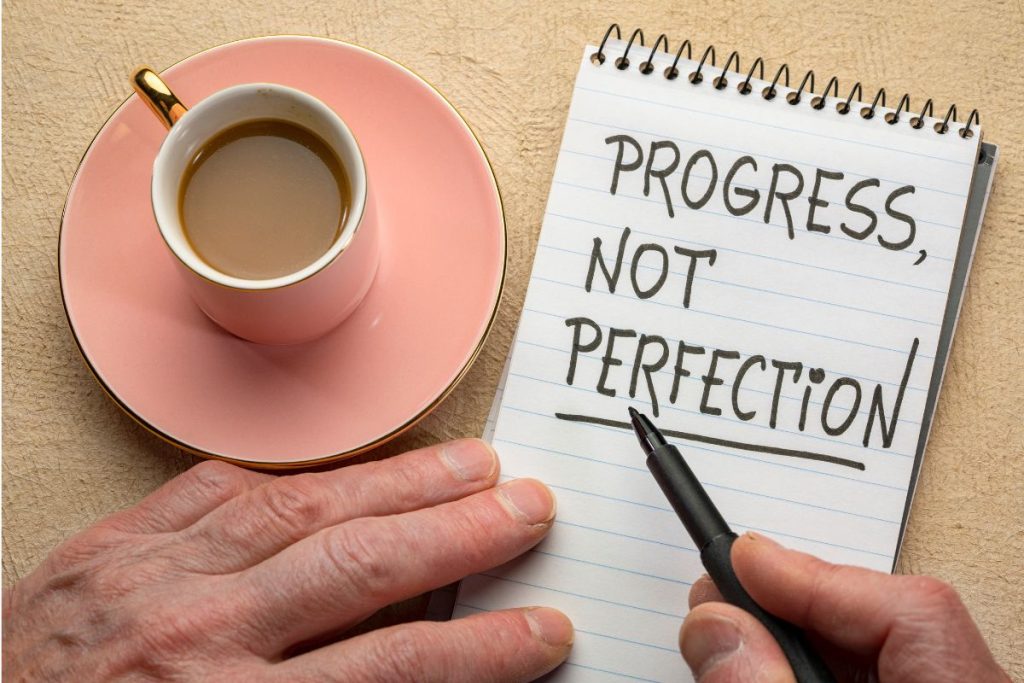
Perfect streaks are a fantasy. Missing once is human. Missing twice in a row is when momentum breaks. The only rule that matters: never miss twice.
This is where most people’s habit plans fall apart. Even I got frustrated by the perfect schedule.
You missed a day, work ran late, you were exhausted, or something came up.
You felt guilty. Then here comes the thought: I’ve already broken the streak. What’s the point in continuing the habit?
That thought is the actual problem: you can’t stay consistent, not the missed day.
Research from University College London found it takes an average of 66 days for a habit to become automatic.
Thus, missing one day had no destructive impact on your long-term habit formation.
Remember the rule that matters: never miss twice in a row. One miss is a pause. Two misses start to feel like the new normal.
Our lives won’t go in a straight line. We might need to rest on specific days. So you don’t have to feel stressed about missing a day.
What to Do the Day After You Skip
Don’t reset. Don’t restart. Don’t wait for Monday.
Start small with the habit today, right now.
The following routine is what I’ve been doing when I’m busy with my full-time job or need to attend some events.
- Skipped reading? Read one paragraph.
- Skipped the skill-building session? Watch a 5-minute video.
- Skipped the workout? Walk back and forth in your home.
The goal isn’t to make up for what you missed. The goal is to keep the identity alive: you’re still someone who does a particular habit. That one small act resets the clock.
Recovery speed matters more than streak length.
It’s not about getting perfect with your streak. It’s about getting back on track quickly.
How Long Does It Actually Take to Build a Good Habit?
Forget the 21-day myth. The real average is 66 days, but the first two weeks are the hardest. If you survive those, the habit starts to get easier.
The popular claim is that habits take 21 days to form. That number came from a 1960s plastic surgeon who noticed patients took about 21 days to adjust to their new appearance.
Find out more about the 21/90 rule.
However, according to the 2010 study published in the European Journal of Social Psychology, which followed 96 people over 12 weeks, the actual range was 18 to 254 days, with an average of 66 days.
The complexity of the habit mattered; simple habits, like drinking water, formed faster; behavior-based ones took longer.
This means that:
- The first 2 weeks are the hardest. Expect friction and challenges. That’s normal, not a sign the routine isn’t working.
- Don’t compare your timeline to anyone else’s. Your schedule and starting point are different from those of others. Fully focus on yourself.
- Focus on reps, not days. Showing up 40 times every day is stronger than doing it only 13 times throughout 40 days, when life gets busy.
One day, you’ll notice you execute the habit without thinking much. That moment is the signal. You’re there.
8 Powerful Habits of Effective People You Can Start Today
Effective people don’t rely on motivation. They build small, repeatable systems. These 8 habits are common across high performers, and none of them require a perfect day to execute.
You don’t need to do all eight. Pick one that matches where you are right now, and act.
As we’ve mentioned, don’t wait for perfection.
Explore 12 powerful habits that you can do and track that change your life.
Habit 1: One-Task Focus
Multitasking kills depth. Pick one thing to move forward each evening, even if it’s only 5 to 10 minutes. Effective people don’t do more tasks simultaneously. They go deeper for quality.
Habit 2: Daily Review
Before bed or after work, spend 5 minutes asking yourself: What actually matters today, and what’s the one thing that you want to focus on first tomorrow? The review keeps your habits from becoming overwhelming on your list.
Habit 3: Consistent Sleep and Wake Time
Sleep is not simply rest and recovery. It’s the system that determines how much cognitive fuel you have the next evening, actually, to execute your habits.
Irregular sleep creates low energy, and energy is the foundation your habits run on.
Habit 4: Deliberate Learning
10 to 20 minutes a day on a specific skill adds up to 60–120 hours per year. Most people underestimate the power of that.
The habit has to be deliberate: focused, slightly challenging, and not passive consumption.
Habit 5: Daily Movement
You don’t need to hit a gym. A 15-minute walk after dinner reduces mental fatigue, improves mood, and creates a transition between work brain and rest brain.
The short daily walk also quietly helps you build the identity of someone who moves every day.
Habit 6: Reduce Decision Points
Place your sports shoes beside your bed the night before. Clean your workspace before you sit down. Choose tomorrow’s habit before you go to sleep. Every decision you remove saves your mental fuel for the moments that matter.
Habit 7: End-of-Day Shutdown Ritual
A clear signal that the workday is over helps prevent confusion between work mode and rest mode.
The things you do could be writing your next-day priorities on a notepad, closing all tabs, and literally saying out loud, “Done for today.” Sounds small. Works surprisingly well.
Habit 8: Weekly Reflection
5 to 10 minutes, once a week. Ask yourself: Which habit showed up consistently? Which one died quietly? Why? The reflection process isn’t simply journaling; it’s a system review.
Most people only notice a habit is broken when the routine’s been gone for two weeks.
Habit | Why It Works |
1. One-task focus | Prevents mental overload and builds follow-through muscle |
2. Daily review (5 mins) | Keeps priorities visible instead of reactive |
3. Consistent sleep & wake time | Regulates energy, mood, and decision-making |
4. Deliberate learning (10–20 mins/day) | Compounds into a measurable skill over 6–12 months |
5. Movement (even a short walk) | Resets mental fatigue and improves after-work energy |
6. Limiting decision points before key habits | Reduces choice fatigue at the moments it matters most |
7. End-of-day shutdown ritual | Creates a clear mental break between work mode and rest |
8. Weekly reflection (10 mins) | Knows what’s working and what’s quietly failing |
Why Building Good Habits Feels Impossible After Work
It’s not laziness. After 8 hours of decisions and mental load at work, your brain has nearly nothing left. Most habit advice ignores this completely.
You get home and feel happy. You’re not physically exhausted, but your brain is done.
That’s decision fatigue. Thinking and making decisions throughout your workday drains the same mental fuel you need to start new habits.
By evening, your brain chooses the habits of least resistance: screen, couch, snacks.
Researchers have found that willpower depletes the more you use it. The reason you don’t feel in the mood has nothing to do with your character itself.
If you’ve been blaming yourself for not starting after work, stop. You’ve been fighting your biology without the right tools.
Here’s what actually happens: when the mental cost of starting a habit feels high, your brain instantly ignores the execution plan.
The fix isn’t more discipline. It’s reducing the cost of starting.
What Actually Makes a Habit Stick (It's Not Motivation)
Habits form through a loop: cue → craving → routine → reward. When that loop is weak, or the reward is invisible or too far away, the habit dies. Build the loop first; motivation follows.
You need to understand why habits work at all. And the process is called the habit loop.
The loop can be applied to either building good habits or overcoming the bad ones.
The habit loop has 4 parts:
- Cue: a trigger that tells your brain it’s time to act.
- Craving: the cue that motivates you to perform a habit.
- Routine: the actual behavior or action.
- Reward: the payoff that strengthens the loop.
When you’re trying to build a new habit but quit after a week, the failure almost always occurs because the reward is invisible or too far away.
You exercised today but don’t feel like getting in shape. You read a few pages but don’t feel smarter. The brain doesn’t see a reward in a short time, so it stops you from continuing.
Always remember that overnight success doesn’t exist. And you should do the work to get the desired outcome.
The goal isn’t to feel super motivated before you start. It’s to build a tight habit loop, so the habit runs itself automatically.
The Real Reasons Good Habits Fall Apart, And the Fix for Each
Habits don’t fail because you’re lazy. They fail for specific, fixable reasons. Identify yours, then fix them.
Here’s the diagnostic most habit guides skip:
What You Tell Yourself | What’s Actually Happening / The Fix |
“I always restart on Monday” | Reason: you’re giving yourself delayed permission to fail. Fix: restart today, even with 2 minutes. |
“I can’t be consistent when work is stressful” | Reason: the habit is designed only for a good day, not a real day. Fix: Make the habit easy to start to survive your worst week. |
“I lose motivation after a few days” | Reason: you’re confusing motivation with momentum. Fix: action creates motivation, not the other way around. |
“I do it for a week, then fall off” | Reason: No reward signal after the habit. Fix: add one small, immediate reward right after the behaviour. |
“I keep forgetting to do it” | Reason: the habit has no anchor. Fix: attach it to an existing behaviour using habit stacking. |
“I set too many goals at once” | Reason: cognitive overload collapses everything. Fix: one habit, all energy, 30 days. |
How to Know If Your Habit Is Actually Working
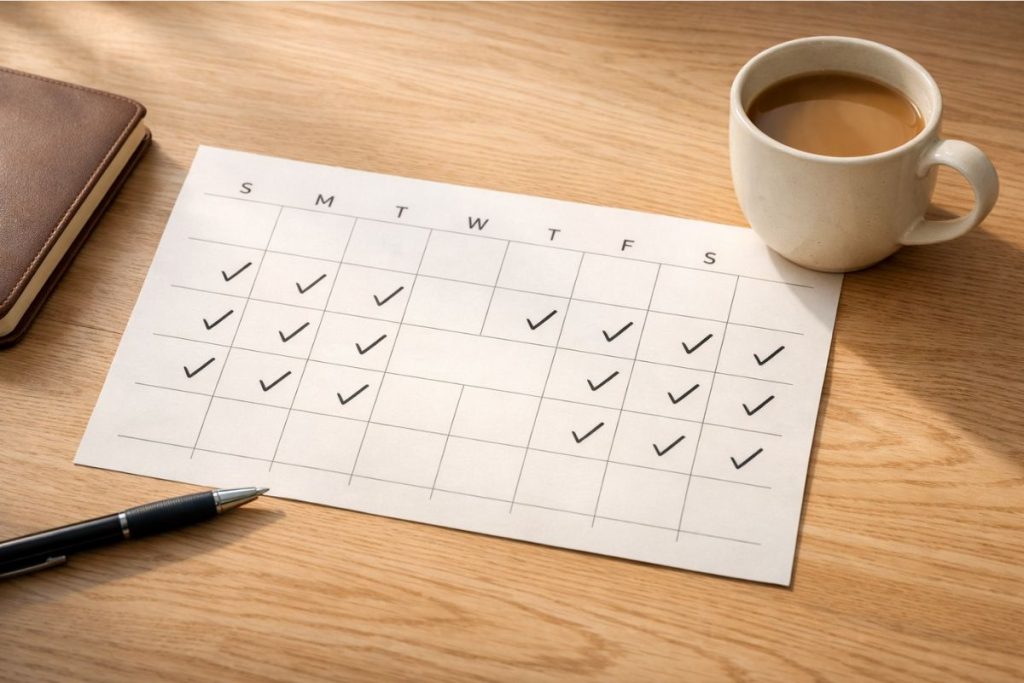
Results come slowly. Leading indicators come sooner. There are some early signals that you’re making progress on a habit, even before the outcomes show.
One reason people quit before a habit works is that they can’t see any progress and assume it isn’t working.
In reality, every execution compounds slowly. They are quietly leading you to the goal.
Measurable results, such as weight loss, skill gains, and side project progress, are lagging indicators. Those lagging indicators take time.
Instead, what you can look for earlier are the leading indicators that the habit is forming:
- You’re doing the habit more than 50% for the following days. Not perfect. Just more often than not.
- It feels slightly less effortful than last week. The mental cost of starting is dropping.
- You catch yourself doing it without deciding to. You just… did it.
- You feel quite off when you skip it, as if something isn’t done. That mild discomfort means the habit has become a part of your routine that you don’t want to miss.
- You stopped making excuses before starting. The internal “maybe later” voice is getting quieter.
If you meet one of the things mentioned above, congratulations, your habit is formed!
Any one of these indicators is a win. Name them when you see them. Most people walk past progress because they’re measuring the wrong thing.
So start monitoring your leading indicators, possibly once a month, and optimize the strategies to succeed in your habit-building journey.
Conclusion: You Don't Need a Perfect Routine to Build Good Habits
Here’s what’s worth remembering: you’ve restarted before. That doesn’t mean you’ve failed or you were born lazy or useless; it means you haven’t quit.
You still try to get involved when things get tough.
Most people trying to develop good habits give up because their approaches and goals were huge, perfect, unrealistic, and dependent on motivation that never shows up consistently.
The real framework is simpler:
- Pick one habit
- Make the habit small enough that you can still do it
- Stick the habit to another one already in your day
- Show up more days than not
- Get back immediately when you skip
That’s how you build good habits that don’t disappear every time life gets hard. Not a dramatic transformation. Not a perfect streak. Just consistent, small reps, until one day you realize you don’t have to decide whether to do the task anymore.
Not Monday or other days when you feel like it. Start the smallest version of one habit today.

[…] you’re thinking about starting a new habit, make sure to check out our related post on how to build good habits with a detailed step-by-step […]
[…] truth is, you build good habits through consistency. Indeed, they go hand in hand because you develop a habit when an action […]
[…] the meantime, here’s another related post you may be interested in: How to build good habits with a step-by-step […]
[…] developing good habits isn’t that complicated. Explore how to build good habits to see […]
[…] to know the clear differences between a habit and a goal, you might be interested in exploring some effective ways to build good habits step by […]
[…] you’ve picked a few good habits and are all set to track, right? Let’s dive into how to build good habits that last. No pressure, but step by […]
[…] If you’ve been feeling stuck on doing things consistently, discover how to build good habits that last. […]
[…] some other effective ways to build good habits in your 20s, when you feel lost. This guidance will help […]
[…] If developing habits has always been difficult for you, check out how to build good habits that last. […]