Cue Craving Response Reward:
Why Change Feels Hard After Work
- Published:
Feel stuck in your life, doing the same things again and again, as if trapped in a loop?
Feel like changing, but end up scrolling on your phone or watching drama rather than doing the tasks that really benefit you?
Want to start a habit that could change your life after work, but always feel drained after work?
If that sounds exactly like you, then you’re not alone. I used to be that person too, and I can definitely relate to you.
Remember that this has nothing to do with laziness. Not at all. The truth is: distractions are all over the place. We can’t control them.
Many people, including you, want to improve. The problem is that work has eaten up most of your energy. You’re in low battery mode, without the fire pushing it,
Change has always been difficult for young adults in their 20s. Distractions are all around us; they can be the phone, TV, entertainment, friends’ invitations, and more. You name it.
Not to mention the root hidden behind all those factors. It’s definitely the habit loop.
In this article, we’ll walk through the habit loop formulation that traps you inside and makes you feel left behind: cue, craving, response, and reward. Without further ado, let’s get into it!
Table of Contents
- What Is the Cue Craving Response Reward Habit Loop?
- How the Cue, Craving, Response, and Reward Quietly Control Your Daily Routine
- Cue: The Hidden Triggers Behind Your After-Work Habits
- Why You Automatically Reach for Your Phone After Work
- Craving: Why Comfort Feels More Attractive Than Growth
- Why Motivation Disappears So Fast After a Long Day
- Response: Why Small Actions Matter More Than Motivation
- Why You Keep Restarting Your Self-Improvement Journey
- Reward: Why Bad Habits Feel So Hard to Escape
- Why Consistency Slowly Rewires Your Life Over Time
- How to Use the Habit Loop (Cue, Craving, Response, and Reward) to Build Better After-Work Habits
- How Small After-Work Habits Can Slowly Change Your Future
- Your Daily Habits Shape the Direction of Your Life
What Is the Cue Craving Response Reward Habit Loop?
Self-improvement books, such as Atomic Habits and The Power of Habits, specifically talk about the things about ‘cue, craving, response, and reward’ in detail.
But don’t worry right now, because we won’t turn this into a science lesson that may confuse you.
In fact, the idea is much easier to understand than it sounds.
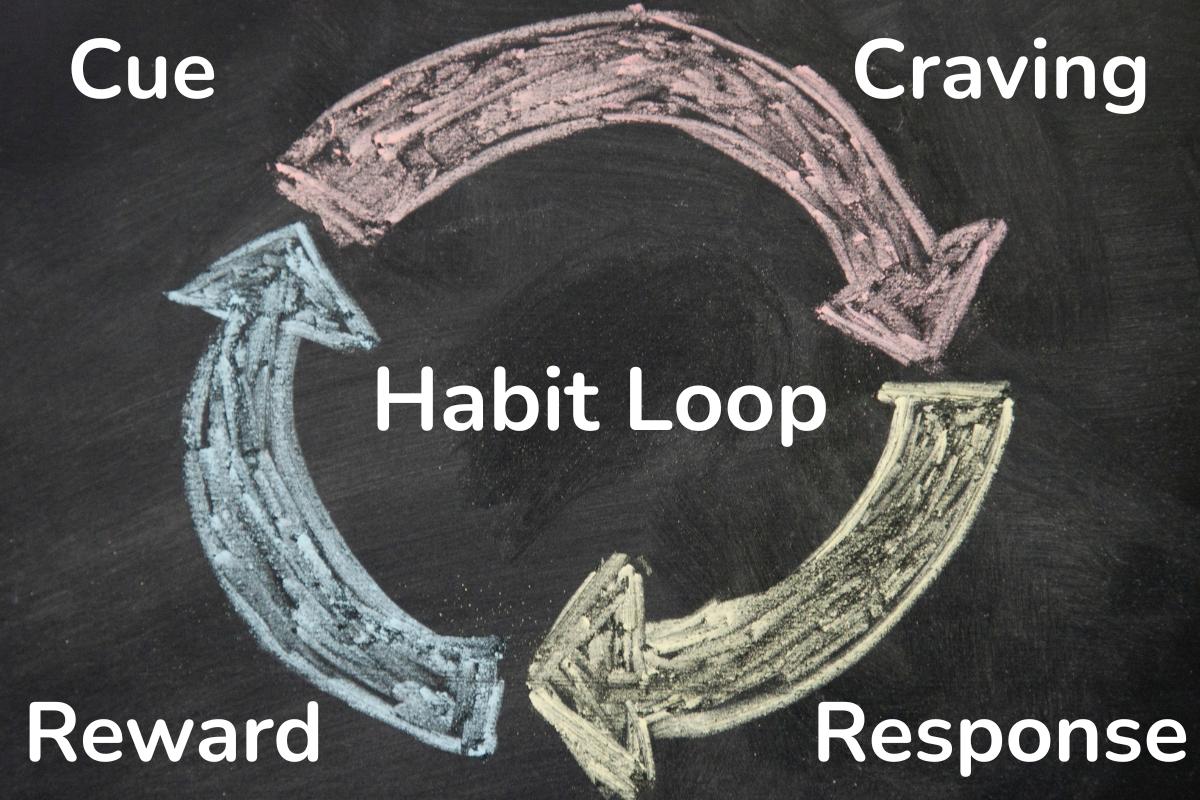
- Cue: the trigger that makes you start a habit.
- Craving: specific things, feelings, or objectives you want to get.
- Response: Actions that you take to achieve the goals.
- Reward: the advantages that you get from doing something.
Pretty straightforward, right? The habit loop that involves ‘cue, craving, response, and reward’ not only influences good habits but also relates to bad habits as well.
If you’ve been feeling stuck on doing things consistently, discover how to build good habits that last.
How the Cue, Craving, Response, and Reward Quietly Control Your Daily Routine

You may not realize it, but the habit loop always works quietly in the background.
The ‘work-sleep-repeat’ lifestyle you live as a young adult who works 9 to 5 is in it.
Rethink the current situation you’re in right now; it may be in this pattern:
- Wake up in the morning
- Clean yourself up and eat breakfast
- Go to your work office by car
- Clock in, and start working at around 9
- Lunch break
- Clock out at 6 in the evening
- Go back, feeling exhausted
- Have dinner
- Spend time enjoying all sorts of entertainment
- Go to bed
Then the following days stay the same. No change.
Most people commonly treat evenings as a default routine instead of an intentional time. Yet those few precious hours are life-changing and lead you to your dream.
They go for instant pleasure, rather than long-term growth. That’s how a good habit is formed. If you’re one of the victims, then check out the effective strategies to overcome bad habits.
The first factor we’ll be looking into is, for sure, Cue.
Cue: The Hidden Triggers Behind Your After-Work Habits

Without the questions, cues play a bigger role than you ever realize.
It can be anything like,
- The specific time
- The environment you’re in, your mood
- The emotions and feelings, such as tiredness, moodiness, stress, and boredom
In your case, it feels like a hassle to focus on improving yourself and growing. But your environment may have set up your next habit before you even notice it.
You’re not in the mood for learning new skills or reading books that would do you good.
Rather, it feels easier and more relaxing to disappear into endless dramas, movies, and social media scrolling.
This is to fill the space that always feels lonely in your mind.
Day after day, you realize you are getting stuck in a repetitive life without a sense of purpose.
Over time, you might start wondering why every week just feels the same. You feel mentally drained. Only negative thoughts and self-doubts are your companions.
Why You Automatically Reach for Your Phone After Work

Most people in their 20s do the same thing. The first thing they do is reach for their smartphone when they feel bored and empty.
You can access countless entertainment and content with a small rectangular device. How powerful is that!
Hold up, because here’s exactly the trigger.
- Get out of work
- Reach home
- Sit on your cozy couch
- Start scrolling.
Those are distractions. Most of the time, we use smartphones without a clear purpose.
The social media, mobile games, dramas, and short videos we enjoy?
This may sound harsh, but it’s the only way to escape the tedious reality. People want to do the things they enjoy most.
Most individuals think that life’s already tough. They shouldn’t spend their free time doing boring and challenging things.
Don’t ever pin that on yourself. It doesn’t mean you’ve failed. If you could stand high in the sky and look down with a bird’s-eye view of every place across the world, most young adults are experiencing this same pattern.
Believe it or not, it’s not really the phone itself you’re craving; it’s actually relief.
Craving: Why Comfort Feels More Attractive Than Growth
When it comes to craving, it’s related to our emotions.
Whether it’s our mood or feelings. You’re looking for something enjoyable and relaxing to do.
Because of that particular reason, you prioritize things that are easier and more comfortable, like entertainment and rest.
By doing so, you break from the pressure from work and escape the current painful, yet boring situation.
Our brain naturally prefers comfort over discomfort. That’s why we always avoid hard things or conversations. That’s literally the fundamental of human nature.
Self-improvement usually requires consistency, patience, and dedication, which is unattractive.
You’d rather spend the evening doing things that you find enjoyable to kill time.
That’s when dopamine gets in the way and stops you from getting your actual things done.
Why Motivation Disappears So Fast After a Long Day
Whenever you feel tired with low energy, your motivation drops significantly.
You don’t feel like doing anything at all during that particular time. Instead, you choose to lie in a bed, sit on a couch, or watch TV. Whatever you feel comfortable with.
That said, literally relying on motivation to do a task is not stable.
It fluctuates as it likes, without giving you notice. That causes a habit not to last longer.
This is why your big plans you’ve always wanted to execute after work or on the weekends are all talk and no action.
You keep waiting for motivation and telling yourself, ‘I’ll do it tomorrow. Somehow, tomorrow never seems to come.
But it’s cruel that it’ll never come to the moments you want. Or perhaps it’ll take forever.
Don’t ever sweat it, because there’s actually one simple trick that always makes things easier.
Keep your action as small as possible, til your brain doesn’t treat it as a threat or resistance.
This is where we’re gonna talk about the next stage: Response.
Response: Why Small Actions Matter More Than Motivation
As you may realize, a response refers to an action you take.
It comes right after the cue and craving.
The action should be small enough that your brain doesn’t resist it. This matters especially when you feel exhausted. That’s the time when the brain treats every task that comes knocking on its door as an ‘enemy.’ It doesn’t welcome them whatsoever.
Making it small is the only way to befriend your mind.
It can be:
- Reading one to two pages of a self-help book
- Watch one educational video on YouTube or Udemy, whatever it takes, to learn a new skill that you’re interested in.
- Apply one skill you’ve learned in use if that’s possible.
Small actions are always better than perfection. Remember this: you don’t have to figure out everything all at once.
Believe it or not, you’ll feel like doing more, and everything will just flow naturally along the way. You don’t feel enough as the momentum goes strong.
Don’t beat yourself up when things feel slow. That’s how real progress looks. Flat but steady.
If you find yourself procrastinating most of the time, then this article may be a helpful guide for you: How to stop procrastinating and get things done.
Why You Keep Restarting Your Self-Improvement Journey
This is the pattern that you must have been through:
- Feel motivated and start excited
- Stay consistent for a few days, and the process goes smoothly
- Progress slows down
- Lose motivation
- Quit the process
- Motivation appears again and restarts the process.
Then it rewinds and stays the same.
Most people may think they don’t have a specific desire or interest in doing something, so they can’t stay consistent.
But that’s not necessarily true. The problem lies in the response you give yourself.
The reason you fail is that you take a huge leap at a time, hoping for overnight success.
In reality, that doesn’t exist.
Meanwhile, you execute an action without having a clear goal in mind. And you only get involved in the process when you feel like it, wholly your emotions.
Hence, an organized, realistic goal and a habit system matter. It lets you stay in the game, even when things happen, or you aren’t in the mood.
Reward: Why Bad Habits Feel So Hard to Escape
It’s often pretty challenging to break bad habits. The reason is simple: people can get quick rewards that make them feel good and satisfied, without going out of their way.
It makes clear sense when it comes to the activities you do after work or on the weekends.
Mindless activities give you instant comfort and relief, without thinking much or making an effort. You’d be annoyed if someone told you to do activities that you dislike when feeling tired, right?
Yes, that’s what our brain really favors. It loves the things that it’s already familiar with. It doesn’t want to change.
The brain automatically learns which activities give fast relief, whether it’s endless dramas, short videos, gaming, or social media.
That’s the reason you don’t feel like getting away, as the process is overly soothing.
So it makes you feel great to repeat that bad habit, not feeling resistance,
But once you stop playing, you’re going to feel empty instantly, as if losing something that matters to you.
The same goes to bingewatch endless drama and movies.
Why Consistency Slowly Rewires Your Life Over Time
When it comes to building good habits, you may often wonder, ‘I’ve been doing it for quite some time.Why haven’t the results I want appeared?’
That’s the doubt that most people give up in the earlier stage. It’s not that the positive outcomes don’t want to show. It’s just that rewards tend to be slower and time-consuming.
You may not notice changes instantly, but each action that you repeat is getting your brain used to a new identity.
They help you build confidence and discipline in yourself that keeps you going.
You can figure out the exact direction you want to head towards and eventually enjoy your life.
No matter what they’re
- Having a small business or project that could make 5 figures in the near future.
- Thrive in the career you love the most
- Travelling across the countries
- Knowing multiple languages and speaking to people from other countries in their languages
- Living a fulfilling life
What matters is staying in the game long enough without backing out, even though things are hard ahead with a lot of stepping stones.
The life you dream of is definitely possible, but the first important step to take is to put in the reps and build a lasting momentum.
How to Use the Habit Loop (Cue, Craving, Response, and Reward) to Build Better After-Work Habits
Based on what we’ve discussed above, you might have a clear picture of how the ‘cue, craving, response, and reward’ framework gets you stuck in the current bad habits or situation.
But the habit loop can also be applied to building good habits.
You don’t have to wait for a perfect moment to start this. You can design a simple and effective habit loop right now.
Take a piece of paper and write it down, and treat it as a reminder to review and follow it through. It’ll be very useful.
Here’s what a simple habit loop looks like with examples:
- Choose one cue: let’s assume the cue is the time right after having your dinner in the evening.
- Understand your craving: pursuing a meaningful career that you love, like maybe becoming a digital marketer or content writer.
- Pick one small response: Spend only 5 to 15 minutes at the start, learning the related skills through online courses or free videos on YouTube
- Include satisfying rewards: It can be successfully getting the job you really like or utilizing those skills to earn passive income that supports your life.
No rush, but one habit at a time. It’s definitely not about changing your life overnight. But when you keep going every day, even if there’s no applause from others at first, you won’t regret it because things will eventually pay off. Trust the progress itself.
How Small After-Work Habits Can Slowly Change Your Future
These small, quiet actions may seem lackluster now, but they gradually create opportunities your future self will appreciate.
They actually contribute to long-term growth when added up little by little every day.
Your evenings and weekends are more valuable than you realize. Unfortunately, most people in their 20s often ignore this. They trade it for other leisure activities that give them short-term relief.
That’s a small, hidden window for activities that lead to success and significantly change you. Here are some that sound unglamorous, but the effect really takes off in a tremendous, positive way that you’d never imagine.
- Learning and building skills that people can’t take away
- Reading books full of wisdom, lessons, and tips that are useful in the coming years
- Exercising to keep yourself in good shape, and bring you confidence
- Working on a small project that you’ve never told your boss or colleagues about will give you a great opportunity to jump out of your current situation
The best part is They don’t require intense plans and moves. The main goal isn’t to do more. It’s to make sure your free time is slightly more intentional. What matters is ensuring the streak keeps rolling.
2 hours are too much? Then go for 30 minutes? Still over your limit? Then 5 minutes first. Do it at your comfort, as long as there’s progress and you learn something new, even if it’s only a small improvement. Makes it count, and time will tell.
Your Daily Habits Shape the Direction of Your Life
The great life that you’ve been pursuing depends on the repeated habit loops that you’re in.
Habits shape your future when you keep going with small routines when nobody is watching and cheering. And, perfect moments don’t exist in real life; waiting for them will only take you forever, and keep you standing still in a circle that you’ve always been in.
You may miss out on a lot of great opportunities that could’ve been yours to grab.
So start now, with just a simple habit loop or step. You’re almost there, and are doing great, as you thought of.
Maybe you want to master a skill you’ve longed for.
Maybe you want to lose weight, read more, or start something meaningful.
You don’t need to change everything today. One small step after work is more than enough.
Life’s not gonna wait for you for a lifetime.
With the habit loop that involves cue, craving, response, and reward, you can eventually get rid of the feeling of ‘I’m lost and don’t know what to do in life’ and slowly rebuild direction through small, consistent actions that will finally ladder up to a huge mountain.
[…] fact, this is the habit loop called “cue, craving, response, reward” that you’re stuck […]
[…] feels rough to get stuck in this cycle (we call it the cue-craving-response-reward loop). Deep down, you want to change, but fear stops […]
[…] You need to understand why habits work at all. And the process is called the habit loop. […]